
Dental compressor not working?
If your chairs have no air, your handpieces are not running or your 3-in-1 syringe has stopped working, a compressor fault is one possibility, but many causes are simpler to identify.
First, what does a dental compressor do?
The compressor supplies pressurised air to equipment including dental chairs, handpieces and 3-in-1 syringes. When that air supply is interrupted, several surgeries may appear to fail at once.
The checks below are designed to establish whether the compressor is producing pressure and receiving power. They do not involve opening the machine, removing covers or carrying out a repair.
Dental compressor fault checks
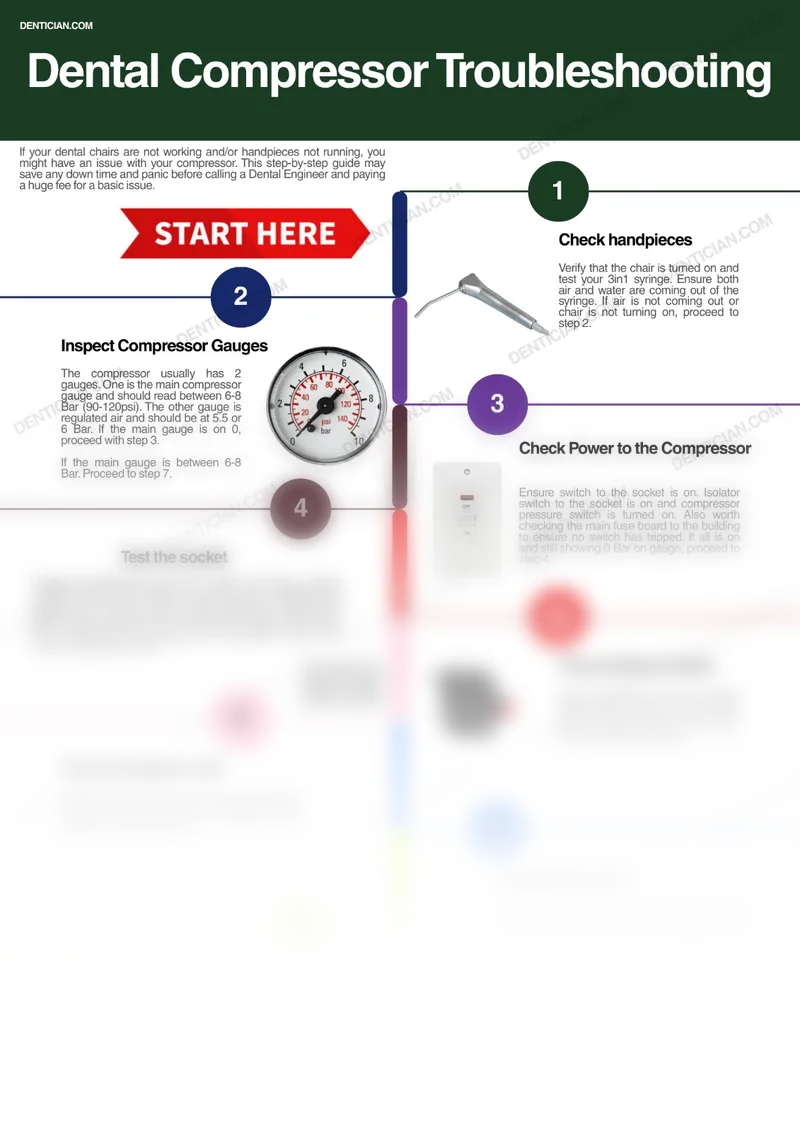
Check your handpieces and 3-in-1 syringe
Test the chair and the air and water buttons separately. If both air and water are coming out, the compressor is producing air and the problem is more likely to be within the chair or an air leak between the compressor and the chair.
If no air is coming out, continue to the compressor gauges.
Read the compressor pressure gauges
Most dental compressors have two gauges. The main receiver gauge will usually sit around 6–8 bar when the compressor has built pressure. A regulated outlet gauge will commonly show around 5.5–6 bar.
If the main gauge is at zero, the compressor is not running or is not building pressure. If both gauges show normal pressure but the chair has no air, the fault is probably elsewhere in the air supply.
Check the obvious switches and fuses
Before assuming the compressor has failed, check:
- the relevant switch on the main fuse board;
- the wall socket and any local isolator switch;
- the plug fuse, usually 13A where a standard plug is fitted; and
- the power switch on the compressor itself.
Only make routine visual checks that your practice procedures permit. Do not open covers or attempt electrical work.
Test whether the socket has power
If it is safe and permitted to do so, unplug the compressor and test the same socket with a simple device such as a phone charger.
If the charger works, power is reaching the socket and the issue is more likely to be within the compressor. If it does not, an electrician or your facilities contact may need to check the supply.
Try the thermal reset once
Some compressors have a clearly marked external thermal-reset button, often red. If the manufacturer’s instructions identify one, press it once and listen for the compressor starting.
If it starts, monitor it. If it trips again, the compressor may be overheating, struggling or overdue for service. Repeatedly resetting it is not a repair. If nothing changes, stop and arrange further support.
When you need to call an engineer
If you have confirmed power and the compressor still does not run, the fault is likely to be internal. Common possibilities include a failed capacitor, pressure switch, internal fuse or motor, or a compressor that is ageing or undersized for the practice’s demand.
Before you call, make a note of:
- the compressor make and model, usually shown on its label;
- which checks above you completed;
- whether it starts, hums, clicks, trips or remains silent; and
- the readings shown on both pressure gauges.
This gives the engineer a clearer picture and can reduce wasted diagnostic time on site.
Keep the fault checks beside the compressor.
Enter your email to unlock the one-page checklist. It opens here on the website, ready to view or download. Nothing will be emailed to you.
Ask Dentician to look at the fault with you.
Tell us what you have checked and what the compressor is doing. We’ll give you an honest view of the sensible next step.